Many people may have heard the term “NHRI” (National Human Rights Institute) before, but may not yet know the basic principles, origins, and reasons behind the establishment of human rights institutions in a country.
According to the definition by GANHRI (Global Alliance of National Human Rights Institutions), a human rights institution must play an important role in promoting and protecting human rights for everyone under the sovereignty of that country. Such institutions should be established and recognized by the constitution and government, with the authority to investigate and protect human rights for all individuals.
They should receive an adequate budget from the state to carry out their work and must maintain independence — free from the influence of the state or any other power. One key role is to propose solutions to human rights issues to the national government. Human rights institutions should also adhere to international human rights principles to help ensure that the country develops in line with global standards.
According to international principles, every country should have a human rights institution to oversee and protect human rights.
Let’s learn together about the national human rights mechanism — its origin, roles, and importance.
#NHRI #NHRCT #PEF #humanrights
The Principles Behind the Establishment of National Human Rights Institutions
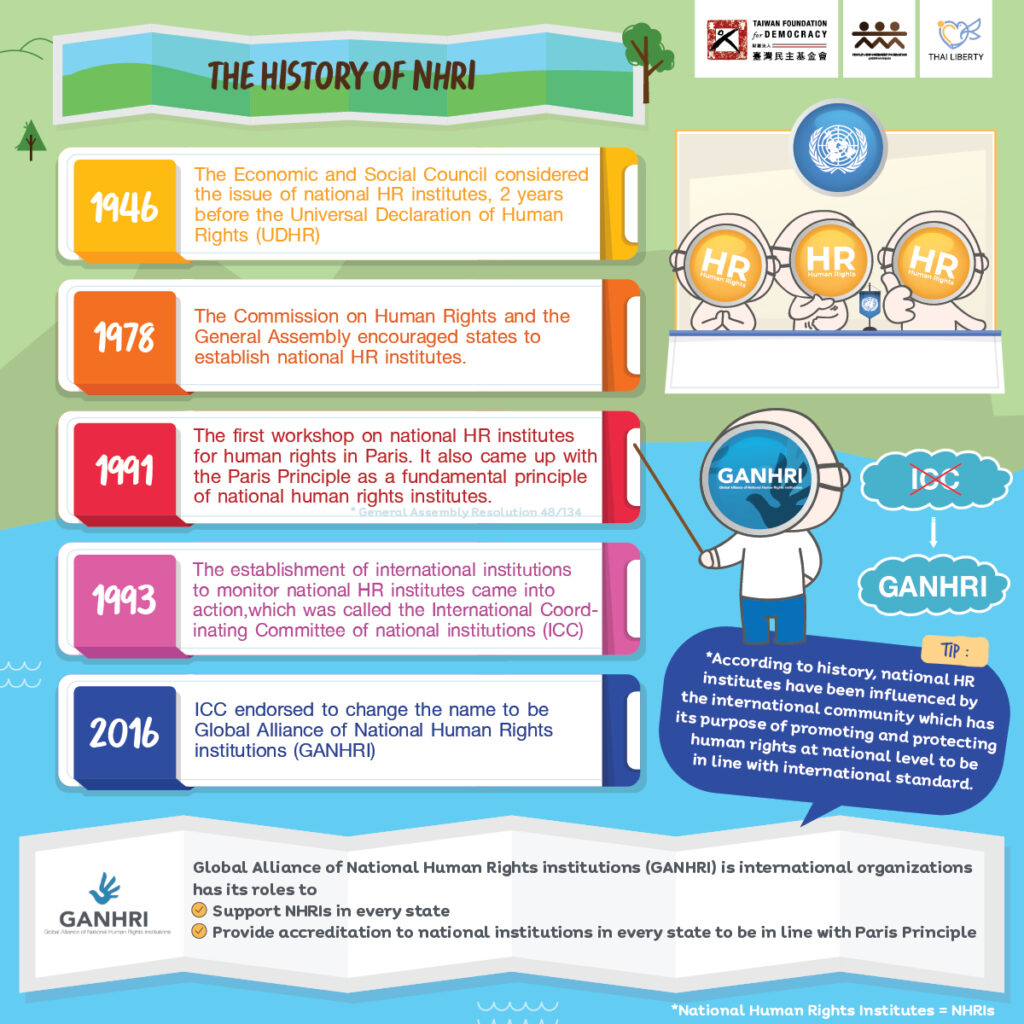
The principle of establishing national human rights institutions is actually an international principle that originated in discussions at the United Nations. It was first mentioned in 1946, when the United Nations Economic and Social Council (ECOSOC) proposed that each government should establish a national human rights institution (NHRI) to promote and protect human rights within their own country.
This proposal came two years before the adoption of the Universal Declaration of Human Rights in 1948.
Years later, in 1978, the United Nations Commission on Human Rights raised the issue again at the UN General Assembly, giving the idea renewed momentum.
Then, in 1991, the first training on establishing NHRIs was held in France, which led to the formulation of the “Paris Principles.”
These Paris Principles became the foundational standards for all national human rights institutions around the world — and every NHRI is expected to comply with them.
In 1993, an international body was established to monitor the performance of NHRIs globally. At that time, it was called the International Coordinating Committee of National Institutions (ICC).
Later, in 2016, it was renamed the Global Alliance of National Human Rights Institutions (GANHRI). GANHRI plays a key role in supporting NHRIs worldwide and accrediting them based on whether they comply with the Paris Principles.
TIP:
The first country to establish a national human rights institution was Australia, in 1970. Later, New Zealand and the Philippines followed.
The Paris Principles
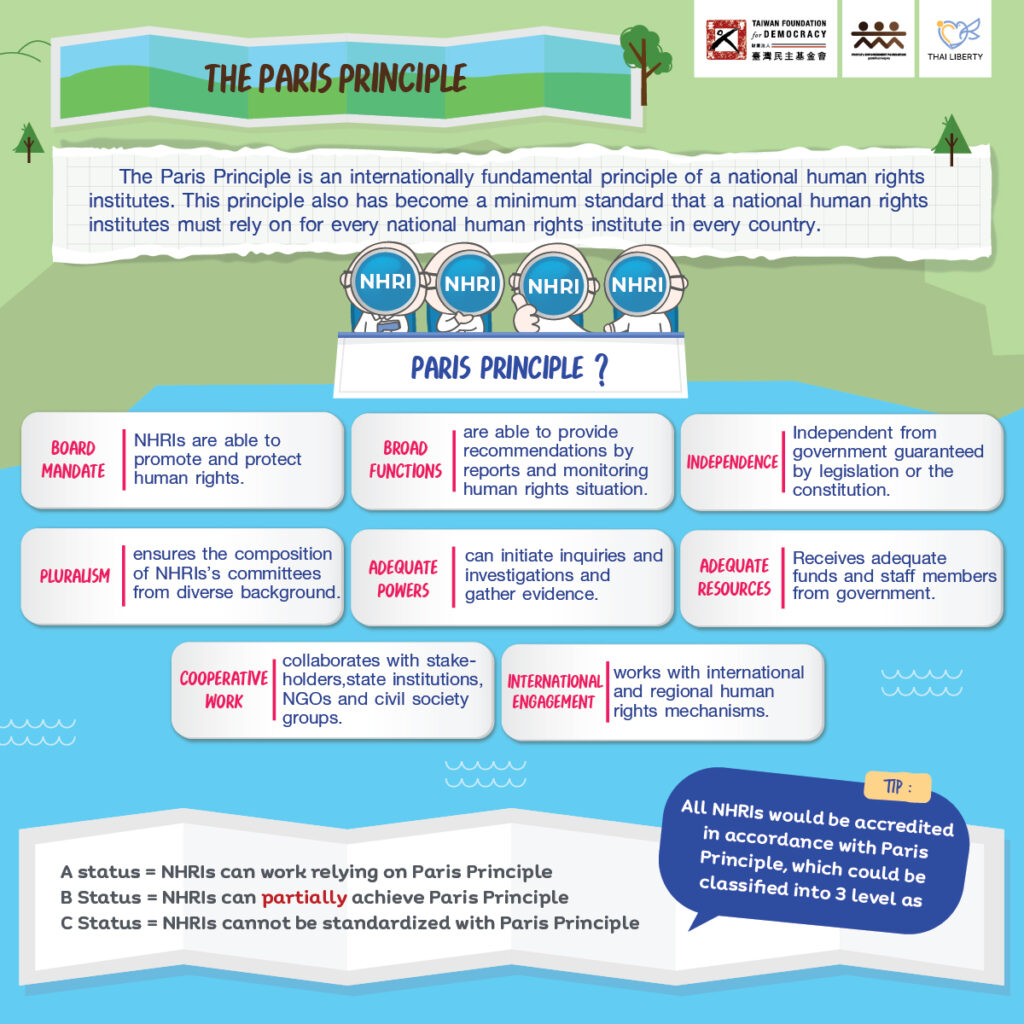
The Paris Principles are considered the fundamental international standards for National Human Rights Institutions (NHRIs). Every government must ensure that their NHRI is given the following roles and powers in the field of human rights:
- Board Mandate
– To promote and protect human rights through advocacy and public engagement. - Broad Functions
– To make recommendations, monitor human rights violations, handle complaints, and provide human rights education. - Independence from the Government
– NHRIs must operate independently from the state and be established under the constitution or legal framework. - Pluralism
– The composition of the NHRI should reflect diverse social representation. - Adequate Powers
– NHRIs must have the authority to investigate and access documents and evidence needed to conduct inquiries. - Adequate Resources
– They must receive adequate funding, personnel, and resources to function effectively in the field of human rights. - Cooperative Works
– NHRIs should collaborate with other NHRIs and with civil society organizations (CSOs). - Engagement with International Mechanisms
– They must work in cooperation with regional and international human rights mechanisms.
GANHRI’s Role in Accreditation
GANHRI (Global Alliance of National Human Rights Institutions) evaluates and accredits NHRIs based on their compliance with the Paris Principles. Accreditation is classified into three statuses:
- Status A – Fully compliant with the Paris Principles
- Status B – Partially compliant with the Paris Principles
- Status C – Not compliant with the Paris Principles
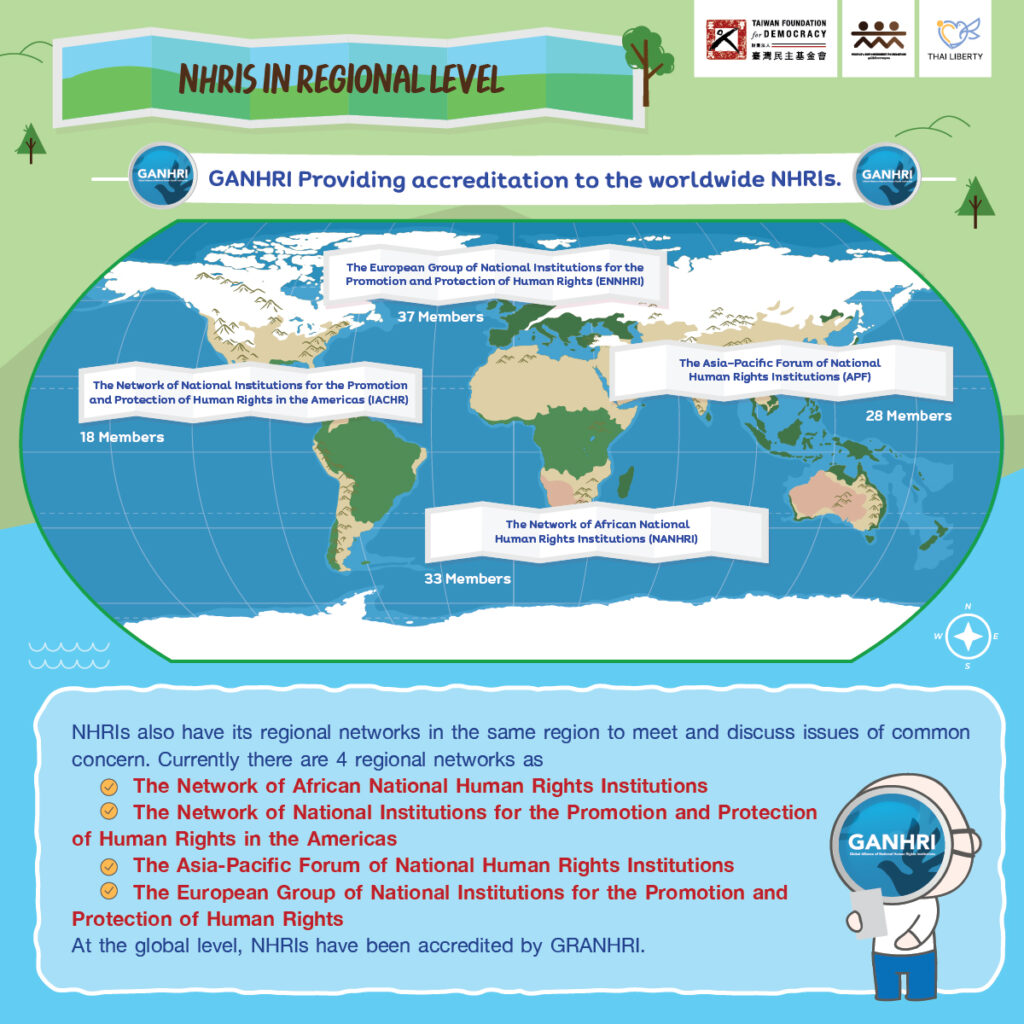
Regional and Global Cooperation of National Human Rights Institutions
National Human Rights Institutions (NHRIs) must not work in isolation — they are also expected to collaborate at regional and global levels. In each region, regional networks have been established to facilitate cooperation, dialogue, and discussion on human rights issues across countries.
There are four main regional networks, divided by region:
- The Network of African National Human Rights Institutions (NANHRI)
– Comprising 33 member countries - The Network of National Institutions for the Promotion and Protection of Human Rights in the Americas
– Comprising 18 member countries - The Asia-Pacific Forum of National Human Rights Institutions (APF)
– Comprising 28 member countries - The European Group of National Institutions for the Promotion and Protection of Human Rights
– Comprising 37 member countries
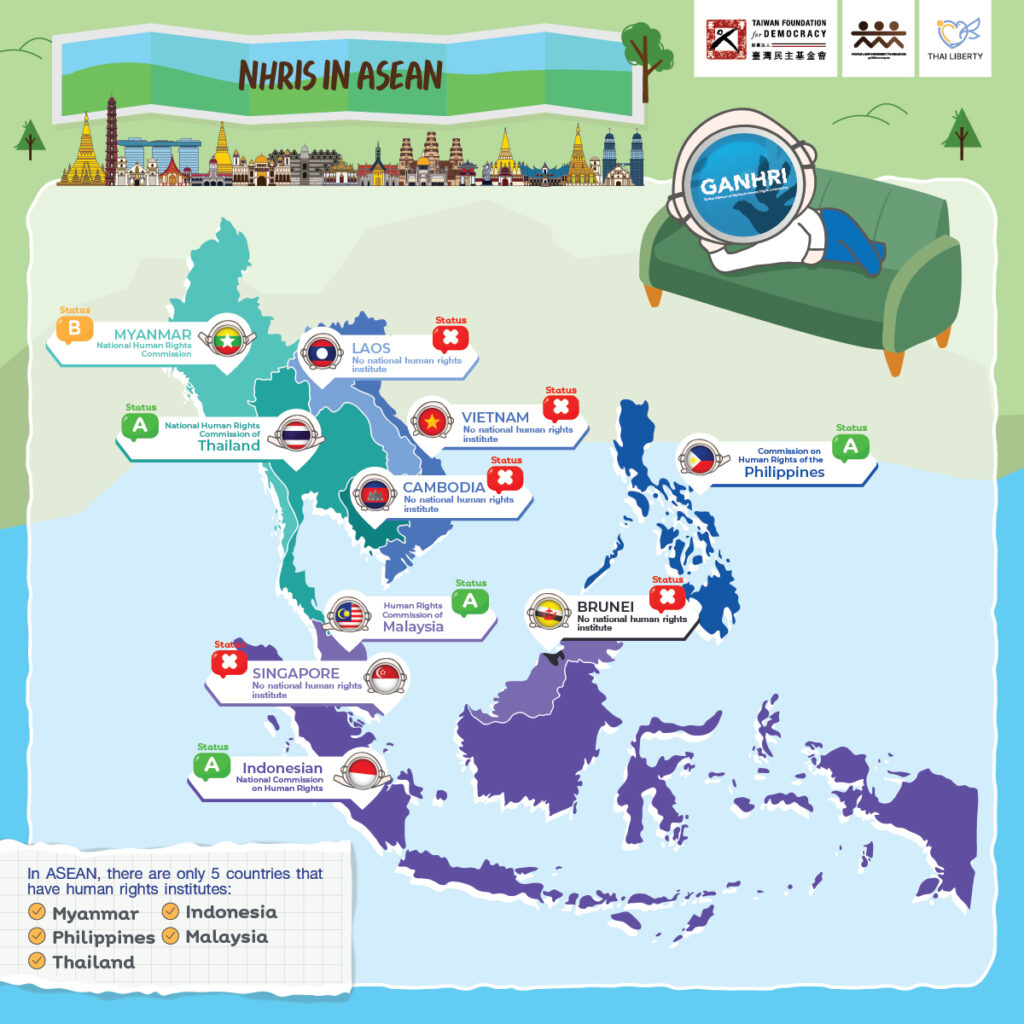
NHRIs in the ASEAN Region
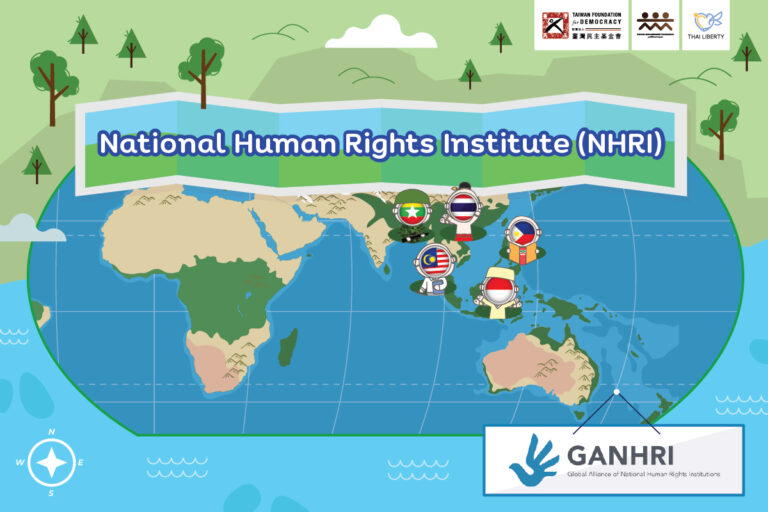
Currently, within the ASEAN region, only 5 countries have established National Human Rights Institutions (NHRIs). These countries are:
- Myanmar
- Thailand
- Philippines
- Indonesia
- Malaysia
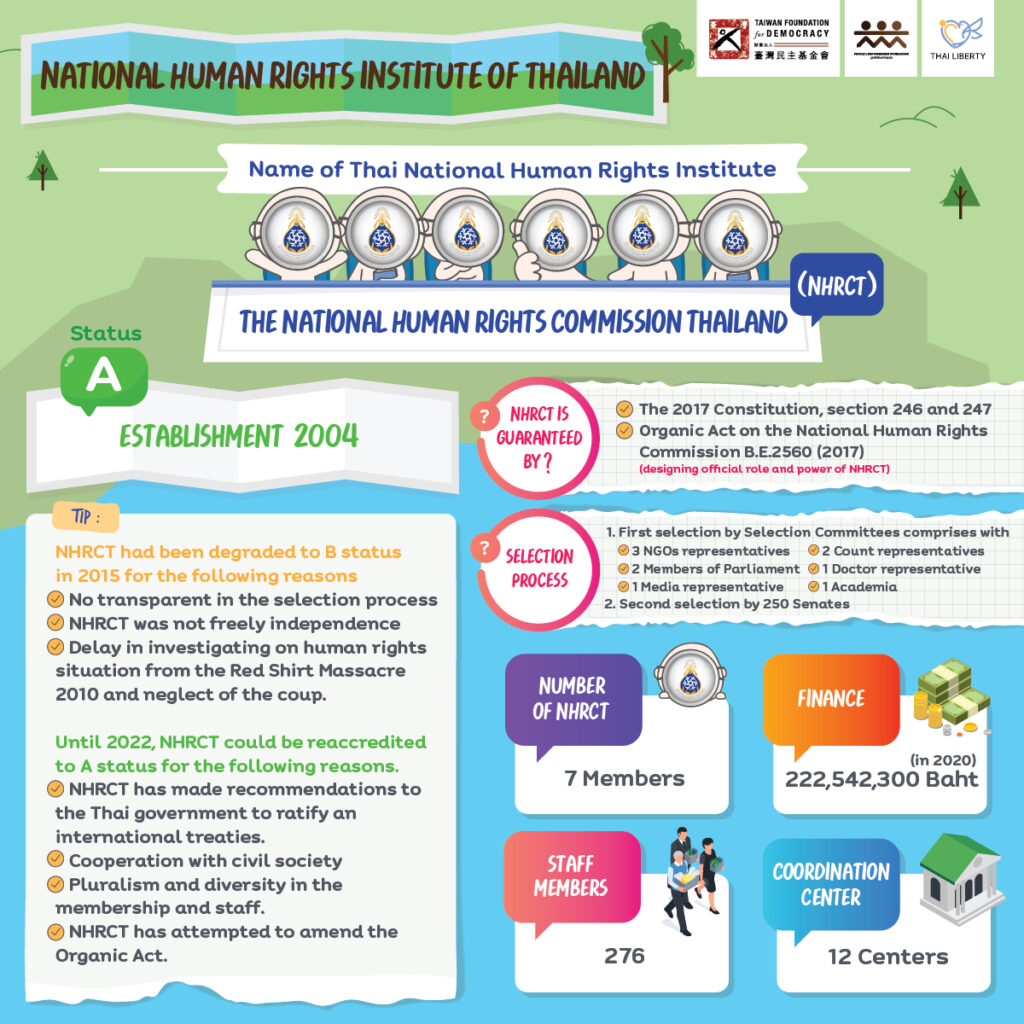
Thailand’s National Human Rights Institution
Thailand’s National Human Rights Institution was established in 2004, under the official name:
“The National Human Rights Commission of Thailand (NHRCT)”
(Thai: คณะกรรมการสถาบันสิทธิมนุษยชนแห่งชาติ หรือ กสม)
The current NHRCT is recognized by the 2017 Constitution (Sections 246 and 247), and its authority and structure are further governed by the Organic Act on the National Human Rights Commission B.E. 2560 (2017).
Key Legal Framework
- The Organic Act B.E. 2560 outlines the selection process for commissioners, involving a selection committee and requiring Senate (Upper House) approval.
Accreditation Status
- In 2015, Thailand’s NHRCT was downgraded to Status B due to concerns about its independence and effectiveness.
- In 2022, it regained Status A, reflecting compliance with the Paris Principles.
Current Structure & Resources (as of 2020)
- 7 commissioners (as stipulated in the 2017 Constitution)
- Budget: 222 million Baht
- Personnel: 276 staff members
- Regional Presence: 12 coordination centers across Thailand
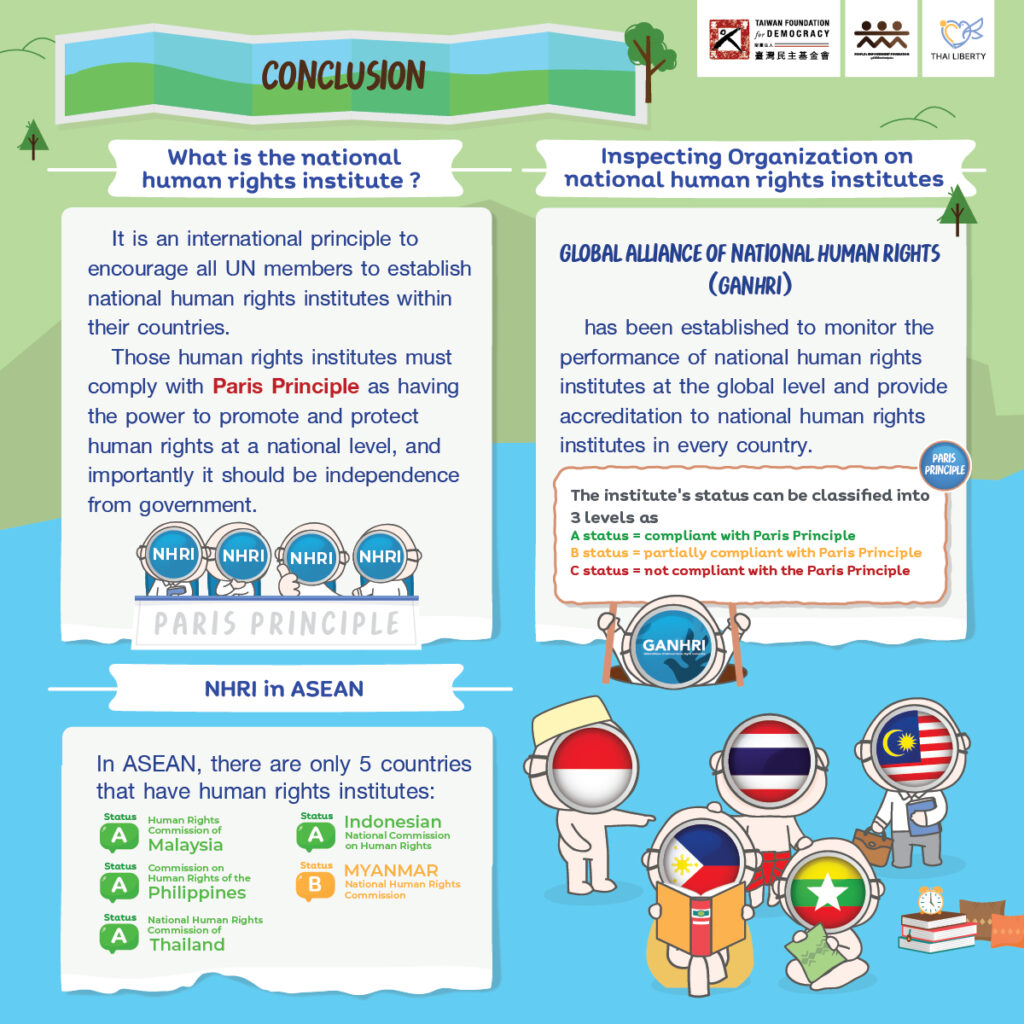
Summary
National Human Rights Institutions (NHRIs) are part of a universal principle promoted by the United Nations to encourage member states to establish national institutions dedicated to human rights. These institutions should be grounded in the Paris Principles, which serve as the foundational standard for all NHRIs. Their role is to promote and protect human rights within the scope of a country’s government, while maintaining independence from the state.
The work of these institutions is monitored and reviewed by the Global Alliance of National Human Rights Institutions (GANHRI), which evaluates whether each NHRI operates in line with the Paris Principles. GANHRI also grants accreditation status based on compliance with those standards.
As of now, only five ASEAN countries have established NHRIs:
- Myanmar (Status B)
- Thailand
- Philippines
- Indonesia
- Malaysia
Among these, Myanmar is the only one currently classified as Status B, while the others are accredited with Status A.
*** Update: Myanmar NHRI was recently removed in Dec 2024 from its global accreditation and regional membership. ***